
If your SASSA identity verification keeps failing, the issue is often simpler than it looks. In 2026, a large number of SASSA rejections are not caused by ineligibility but by photo-related errors or incorrect information captured during the application process. Many applicants submit valid IDs and still get stuck because the system cannot properly match their photo or personal details with government records.
This guide focuses specifically on fixing identity verification problems caused by poor-quality photos, mismatched facial data, and incomplete or incorrect information. Instead of vague explanations, you will find clear actions that actually help unlock stuck applications and delayed payments.
Why SASSA identity verification fails even when you qualify?
SASSA uses automated identity matching systems that rely heavily on facial recognition and data comparison with Home Affairs records. When either your photo or your application details are unclear, the system flags your application for verification failure.
In recent updates rolled out through 2025, these checks became stricter. The system no longer tolerates blurred images, cropped faces, or inconsistent information. Even applicants who were previously approved can suddenly face problems during reassessment.
Photo-related issues that commonly cause verification failure
Your photo plays a bigger role than most people realize. If the system cannot clearly confirm that the person in the photo matches the ID record, verification stops.
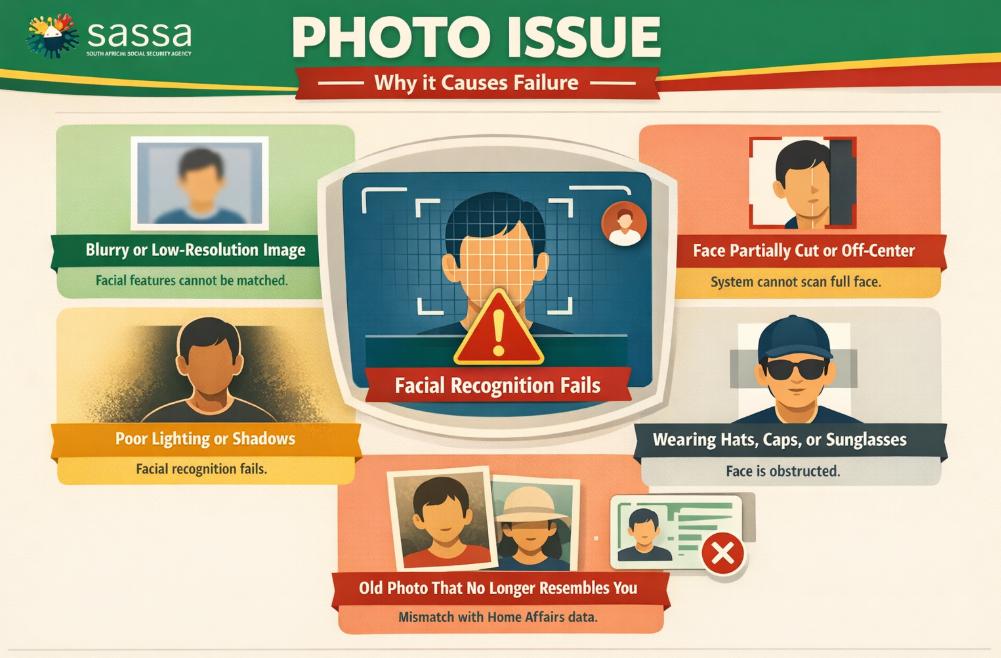
Common photo problems include:
| Photo issue | Why it causes failure |
|---|---|
| Blurry or low-resolution image | Facial features cannot be matched |
| Face partially cut or off-center | System cannot scan full face |
| Poor lighting or shadows | Facial recognition fails |
| Wearing hats, caps, or sunglasses | Face is obstructed |
| Old photo that no longer resembles you | Mismatch with Home Affairs data |
Even if your ID is valid, a poor photo can block your grant entirely.
How incorrect or incomplete information affects identity verification
Apart from photos, many failures happen because information captured during the application is incorrect or missing. This often happens when applications are rushed or submitted from shared devices.
Common information errors include:
| Data problem | Impact |
|---|---|
| Misspelled names or surnames | No match with Home Affairs |
| Missing second names | Partial identity match |
| Incorrect ID number | Immediate rejection |
| Wrong gender or birth date | Verification conflict |
| Incomplete application fields | System cannot finalize verification |
These issues may look small, but automated systems treat them as high-risk mismatches.
How to fix SASSA identity verification when the photo is the problem
If you suspect your photo caused the problem, retaking it properly is critical. In 2026, SASSA photo checks are stricter than ever.
When submitting or updating your photo, make sure your face is fully visible, centered, and clear. Use natural lighting, face the camera directly, and remove any accessories that cover your face. Your photo should reflect your current appearance as closely as possible.
Avoid using scanned photos of photos or edited images. The system prefers clean, original images taken directly from a camera.
Match your photo with Home Affairs records
If your appearance has changed significantly since your ID was issued, the system may struggle to confirm your identity. This is common for people who lost weight, grew facial hair, or aged noticeably.
In such cases, it helps to ensure your Home Affairs records are still active and accurate. Once Home Affairs data is confirmed, SASSA systems usually reconcile the match over time.
How to correct incorrect or incomplete application information
Review every detail carefully
Go through your application and compare every field with your official ID. Names must appear exactly as registered, including spelling and order. Do not shorten names or remove middle names if they exist on your ID.
Many verification failures are resolved simply by correcting spelling errors or filling missing fields.
Update incorrect information instead of reapplying
Submitting multiple new applications creates duplicate records, which makes identity verification worse. Instead, correct the existing application details where possible.
Once updated, allow time for the system to reprocess your information. Verification does not happen instantly and may take several weeks.
Can photo or data issues stop approved payments
Yes. Even approved beneficiaries can face payment pauses if the system triggers a re-verification check. This often happens during audits or when system upgrades occur.
The good news is that once verification clears, payments usually resume automatically. In many cases, missed payments are paid retrospectively.
Financial impact of unresolved verification issues
Delays caused by photo or information errors can affect essential income, especially for households relying on grants.
| Grant type | Estimated monthly amount 2026 |
|---|---|
| SRD grant | R370 |
| Older Persons Grant | R2,180 |
| Disability Grant | R2,180 |
| Child Support Grant | R530 |
Even small errors can lead to months of missed support if not corrected promptly.
How to avoid future SASSA identity verification problems
To prevent repeat issues, always double-check information before submission. Use a clear, recent photo that matches your current appearance. Keep your Home Affairs records updated, especially after name or status changes.
Avoid using shared devices where autofill may insert incorrect details. Keep records of confirmations and reference numbers in case follow-up is needed.
Frequently asked questions
Can a bad photo really cause SASSA identity verification failure?
Yes. Poor image quality or obstructed facial features are among the top reasons for verification failure in 2025 and 2026.
What if my information was captured incorrectly by mistake?
You can correct incorrect or incomplete information. Once updated, the system will reattempt verification.
Should I submit a new application if verification fails?
No. Multiple applications often create duplicate records and delay verification further.
How long does it take after correcting photo or details?
It usually takes between two and six weeks, depending on system load.
Will I get back pay after verification is fixed?
In many cases, yes. Payments may be released for approved months once verification clears.
Conclusion
SASSA identity verification failures in 2026 are often caused by photo quality issues or incorrect information captured during the application process, not because applicants are ineligible. Understanding how facial recognition and data matching work gives you a real advantage in fixing the problem quickly.
By submitting a clear, accurate photo and ensuring every detail matches official records exactly, you remove the most common barriers to approval. While the process may test your patience, corrections do work. Once verification clears, payments usually resume and financial stability follows.
